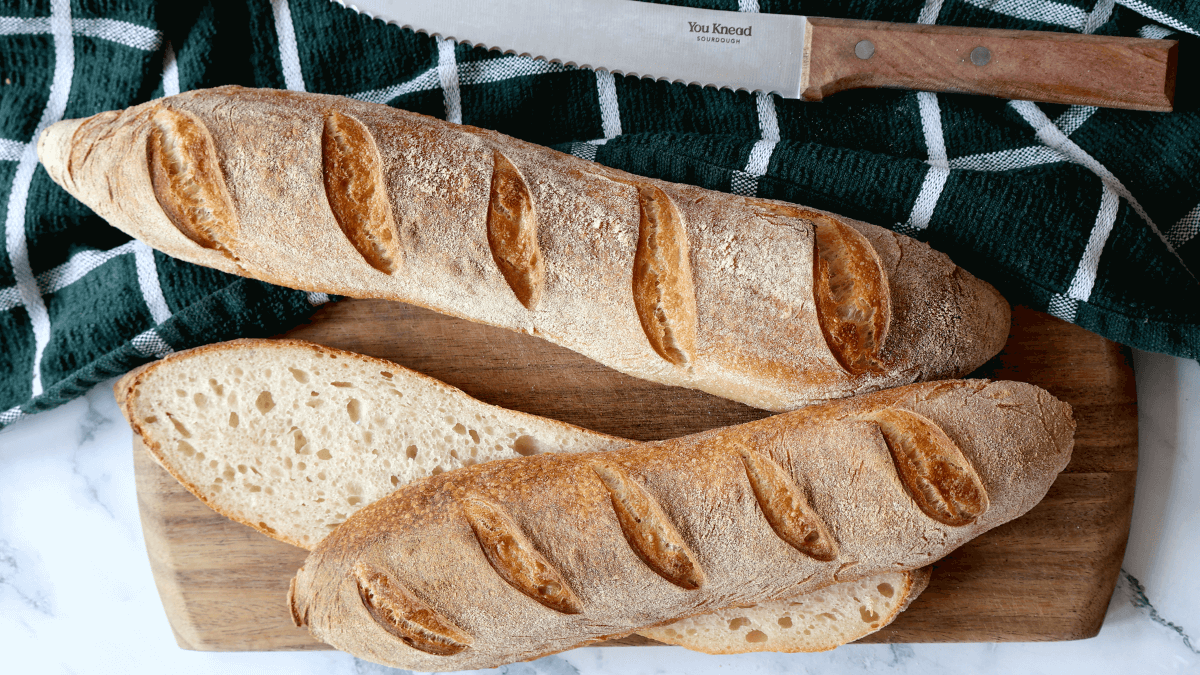
There is something undeniably special about pulling golden, crackly baguettes from your own oven. Crisp on the outside, light and airy on the inside, and deeply flavoured from slow fermentation, this is sourdough at its most elegant.
If you’ve already mastered your basic loaf, baguettes are a beautiful next step. The shaping is a little more hands-on, but once you understand the rhythm of folding, sealing and rolling, it becomes second nature.
And truly, nothing beats slicing into a homemade baguette while it’s still just slightly warm.
Ingredients :
120g active sourdough starter
250g room temperature water
360g bread flour
7g salt
Method:
1. Mix & Autolyse
In a large bowl, combine your starter, water, flour and salt. Mix using a Danish dough whisk until there are no dry spots remaining. The dough will look shaggy, that’s perfect.
Cover with plastic wrap or a lid and allow to rest for 45 minutes.
This rest period (autolyse) allows the flour to fully hydrate and begins gluten development without effort.
2. Stretch & Folds
After the autolyse, begin your stretch and folds.
Wet your hands to prevent sticking. Grab the dough at the “12 o’clock” position, stretch it upward, then fold it back into the centre. Rotate the bowl a quarter turn and repeat. Continue until you’ve worked around all four sides.
Cover and rest for 30 minutes.
Repeat this process every 30 minutes for a total of 4-5 rounds. With each round, you’ll notice the dough becoming smoother, stronger and more elastic.
3. Bulk Fermentation
After your final set of folds, cover the dough and allow it to bulk ferment on the bench.
Bulk fermentation is complete when the dough has increased in volume by approximately 30-50%. This can take anywhere between 4-8 hours, depending on your kitchen temperature.
The ideal room temperature for this dough is 25-28°C.
4. Divide & Pre-Shape
Turn the dough onto a clean bench.
Divide into 2 equal portions.
Using a bench scraper, shape each piece into a loose round to create surface tension. Lightly dust the tops with flour, cover with a clean tea towel, and rest for 15-30 minutes.
This rest allows the gluten to relax, making final shaping much easier.
5. Shape the Baguettes
Lightly flour your bench. Take one round, flip so it’s sticky side up and gently flatten it into a rectangle (landscape orientation).
- Fold the top edge halfway down, like folding a letter. Press to seal using the edge of your hand.
- Rotate 180° and repeat.
- Now bring the top edge down to meet the bottom edge and seal firmly along the seam.
Place seam side down and gently roll into a long baguette shape. Apply slightly more pressure at the ends to create a subtle taper.


Repeat with remaining dough.
6. Cold Proof Overnight
For proofing:
- Using a baker’s couche or tea towel: Flour generously and place baguettes seam side up (smooth side down).
- Using a baguette tray: Lightly spray with oil and flour with semolina or rice flour. Place seam side down (smooth side up).
Cover with plastic wrap or a slightly damp tea towel and refrigerate overnight.
This slow fermentation builds flavour and improves oven spring.

7. Bake with Steam
The next morning:
- Preheat your oven to 250°C. Place a rack in the middle and a baking tray with edges on the bottom shelf (for steam).
- Score each baguette with 3-5 diagonal slashes using a bread lame.
- Transfer baguettes smooth side up onto a lined baking sheet (or bake directly in your tray).

Reduce oven temperature to 220°C.
Carefully pour 1-2 cups of boiling water into the tray on the bottom shelf to create steam. Immediately place the baguettes on the middle rack and bake for 30–35 minutes, or until deeply golden brown.
Steam in the first part of the bake helps create that signature thin, crackling crust.
Cooling the Hardest Part
Remove from the oven and allow to cool completely before slicing. Cutting too early can make the crumb gummy even though it’s tempting.
As they cool, you’ll hear the crust crackle and sing, one of the best sounds in sourdough baking.

Serving Ideas
- Fresh with salted butter
- Dipped into olive oil and balsamic
- Filled with prosciutto, mozzarella and rocket
- Toasted into crostini
- Or simply torn and eaten warm at the bench
Baguettes are simple in ingredients but refined in technique. Once you make them a few times, shaping becomes intuitive and the results are incredibly rewarding.
And when you place a basket of homemade sourdough baguettes on the table? It feels like a little Parisian bakery moment right in your own kitchen.